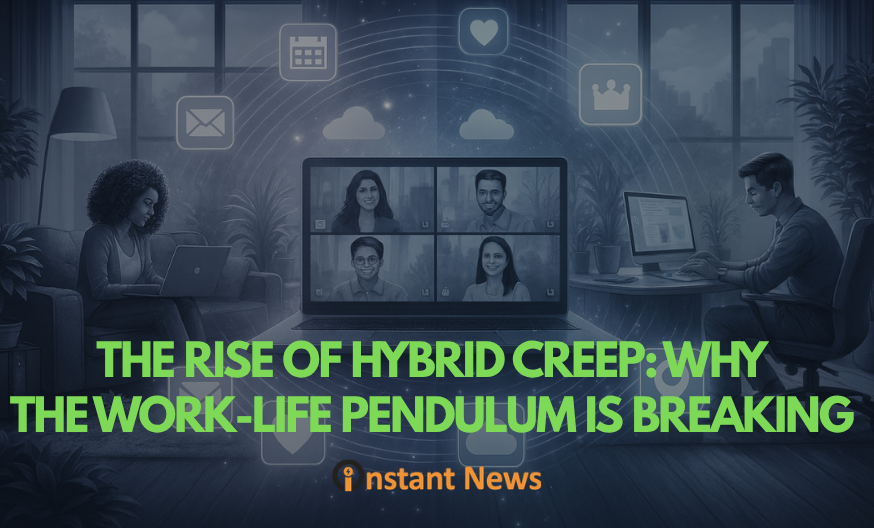
For the past few years, we celebrated the flexibility of the “anywhere office.” But as we move through 2026, a new, more subtle phenomenon has taken hold of the global workforce. It’s called Hybrid Creep, and it is the primary driver of the work-life imbalance currently dominating search trends.
Hybrid Creep occurs when the initial freedom of remote work gradually transforms back into rigid corporate expectations. We are seeing a “pendulum swing” where companies are slowly increasing the required days in the office while still expecting employees to be “digitally present” at home. The result? A workforce that is physically back in the office but mentally still chained to 24/7 digital notifications, destroying any hope of a healthy work-life rhythm.
The Anatomy of an Imbalance: “Phygital” Burnout
The work-life tension in 2026 isn’t just about hours worked; it’s about the “Phygital” experience—the seamless blend of physical and digital presence that never truly turns off.
- The AI “Co-Worker”: Artificial intelligence has evolved into a real “co-worker” that handles scheduling and routine tasks. While efficient, it often removes the natural “breathing room” in a workday, leading to a constant stream of high-intensity demands that bleed into personal time.
- Immersive Overload: We have moved past simple Zoom calls into 3D meeting rooms and virtual whiteboards. These platforms make location-independent work more tangible, but they also make it harder to mentally “leave” the office for a true work-life reset.
- Sensory Fatigue: The modern workplace now uses “multisensory experiences,” like nature retreats in the office, to spark “serendipity”. However, these often blur the line between a place of rest and a place of production, further complicating the work-life boundary.
The Spicy Reality of “Power Skills” and Work-Life Balance
Why does this feel so much more intense in 2026? Because the job market has shifted its focus to “Power Skills”—emotional intelligence, resilience, and social influence. These are essentially “human-centric” skills that machines cannot replicate, yet they require immense emotional labor that drains one’s work-life energy.
The “spice” of this trend is that when you are expected to be empathetic and creative all day—and then go home to an AI-integrated feedback loop that monitors your “tone”—your work-life mental health becomes a strategic business issue. In 2026, nearly half of employees report daily high stress, proving that the scale is heavily tipped toward burnout.
Reclaiming the Boundary: The 2026 Work-Life Balance
To combat this work-life erosion, the most successful professionals are turning to aggressive “Digital Detox” strategies.
- The Technology Curfew: Establishing a strict window where all devices are disconnected to eliminate “solitude deprivation” and protect peace.
- Replacement Practices: Swapping mindless scrolling for hobbies that involve “play” to restore joy.
- Designated Screen-Free Zones: Creating physical spaces where technology is prohibited to safeguard work-life boundaries.
- The “Mocktail” Culture: A shift toward zero-proof social moments that prioritize clarity and wellness.
The Boardroom Response: Well-being as Strategy
In 2026, work-life imbalance is no longer just an HR “perk” to solve; it is a boardroom priority. Burnout-related turnover is costing organizations over $322 billion annually, forcing leaders to rethink the work-life contract.
Forward-thinking leaders are moving toward “evidence-based well-being,” using data to measure psychological safety and ensure a sustainable environment. They are beginning to realize that if a workplace doesn’t allow people to be “human,” it risks losing talent to companies that respect the biological need for a “Digital Sunset”.
Conclusion: The New Goal is “Bio-Harmony”
The most important takeaway for 2026 is that work-life balance isn’t a 50/50 split. It’s about “Bio-Harmony”—the ability to stay productive without sacrificing your nervous system.
As Hybrid Creep continues to challenge our boundaries. The most valuable “Power Skill” you can develop is the ability to protect your integrity. Whether you are navigating an AI-driven labor market. Or a hybrid schedule, remember that you are an ecosystem, not a machine. In the high-speed world of 2026, the spiciest move you can make for your health is to disconnect.