
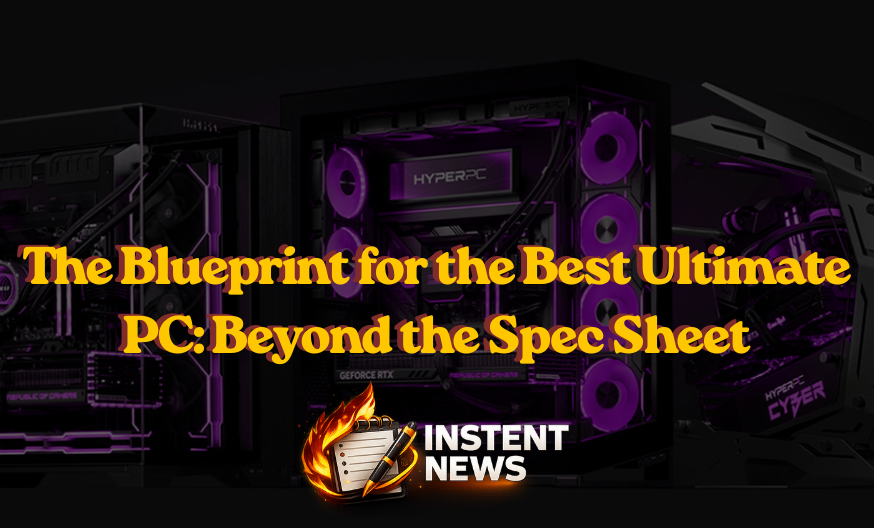
We’ve all seen the flashy YouTube thumbnails. A neon-drenched tower with more RGB than a Las Vegas strip, promising “infinite frames.” But in 2026, the definition of the best ultimate PC has shifted. It is no longer just about who has the biggest GPU or the most cores. It’s about thermal synergy, acoustic harmony, and—most importantly—future-proofing in a world where software demands are evolving faster than ever.
Building a high-end machine today is like tuning a supercar. If you put a jet engine in a minivan, you’ll go fast for ten seconds before the tires melt. To create the best ultimate PC, every component needs to be in conversation with the others.
Silicon Sovereignty: The Heart of the Machine
The core of any best ultimate PC starts with the silicon. In the current market, the battle between the Ryzen 9 9950X3D and the Intel Core Ultra 9 series is fierce. While raw clock speeds are impressive, the “X3D” technology remains the king for gamers due to its massive L3 cache. This cache is the “short-term memory” that allows your CPU to feed the GPU data almost instantly, eliminating those micro-stutters that ruin immersion.
On the graphics front, the RTX 5090 (or its equivalent) is the heavy lifter. But here is the “human” advice: don’t just look at the Teraflops. Look at the VRAM. As we push into 8K textures and AI-upscaling, 16GB of VRAM is the new floor. For the best ultimate PC, you want 24GB or more to ensure your machine doesn’t become a paperweight when next year’s “unoptimized” AAA title launches.
Cooling: From Functional to Fine Art
If heat is the enemy, then your cooling system is the defensive line. In 2026, the best ultimate PC builds are moving away from loud, buzzing fans toward “Phase Change” cooling and massive 420mm AIO (All-In-One) loops.
But it’s not just about liquid anymore. The most unique builds this year are using “Back-Connect” motherboards (like the ASUS BTF or MSI Project Zero series). These boards put all the ugly power cables on the back, allowing for an unobstructed wind tunnel through the front of the case. When you remove the cable clutter, your fans don’t have to work as hard, leading to a PC that is powerful enough to render a movie but quiet enough to sit through a library study session.
The Bottleneck Nobody Talks About: Storage and RAM
You can have the fastest processor on earth, but if your data is stuck in a traffic jam, your PC will feel sluggish. The best ultimate PC requires PCIe Gen5 NVMe storage. We are talking about read speeds of 12,000MB/s. This allows for “DirectStorage” technology, where games load as fast as you can click “Start.”
Pair this with at least 64GB of DDR5 RAM. While 32GB is fine for gaming, a truly “ultimate” machine is often a multi-tasking beast. Whether you are running an SEO audit, editing 4K video, or hosting a local AI LLM (Large Language Model), that extra headroom ensures your OS never has to “swap” memory to the slower drive.
Aesthetics: Building Your Digital Identity
Let’s be honest: if you’re spending this much, you want it to look the part. The trend for the best ultimate PC in 2026 is “Industrial Minimalism.” Instead of rainbow puke RGB, we are seeing a move toward wood accents, brushed aluminum, and “Infini-Mirror” glass. Some high-end cases now feature integrated LCD screens on the side panel that act as a secondary monitor for system vitals or—if you’re feeling fancy—holographic animations.
How to Build It Without Regret
Building the best ultimate PC is a marathon, not a sprint.
- Step 1: The Foundation. Don’t cheap out on the Power Supply (PSU). Get an ATX 3.1 rated unit with at least 1200W. It’s the one part that can literally save your other components from a surge.
- Step 2: The Airflow Path. Ensure you have “Positive Pressure.” This means more air coming in than going out, which keeps dust from being sucked into the cracks of your case.
- Step 3: The Peripherals. An ultimate PC is wasted on a 1080p 60Hz monitor. Match your tower with a 4K OLED display to actually see the pixels you’re paying for.
The Final Verdict
The best ultimate PC isn’t a static list of parts you find on a forum. It’s a balanced ecosystem. It’s a machine that stays cool under pressure, remains silent during the workday, and screams through the latest titles at night. By focusing on the “unsexy” parts—like VRM cooling, cable management, and PSU efficiency—you build a machine that doesn’t just win a benchmark test today, but stays relevant for the next decade.