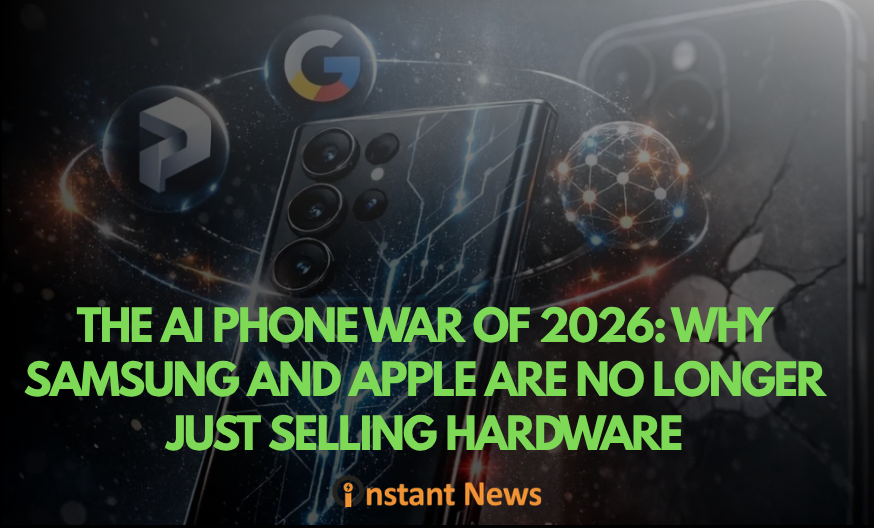
For over a decade, the rivalry between Samsung and Apple was a predictable dance of hardware upgrades. One year, Apple had the better video; the next, Samsung had the better zoom. But as we move into the second quarter of 2026, the rules of the game have fundamentally changed. We are no longer in the smartphone era; we are in the heat of the AI Phone War.
The devices in our pockets today—the Galaxy S26 series and the iPhone 17 lineup—are less about “specs” and more about “agency.” Consumers in 2026 don’t just want a beautiful screen; they want a digital partner that can manage their lives. This shift has turned the AI Phone War into a battle of software intelligence, privacy, and ecosystem integration.
Samsung’s Gambit: The Rise of the Agentic Galaxy
Samsung took an early lead in the AI Phone War by leaning into “Open AI Ecosystems.” The Galaxy S26 Ultra is the first device to fully integrate “Galaxy Agent,” a system that can proactively book flights, manage your calendar, and even negotiate customer service disputes via text.
Unlike the reactive assistants of the past, Samsung’s contribution to the AI Phone War is proactive. If the phone detects a flight delay in your Gmail, it doesn’t just notify you; it offers to rebook your Uber and message your hotel. This “Agentic” approach has appealed to the power-user crowd who want their phone to be a high-functioning executive assistant. By partnering closely with Google’s Gemini 2.0, Samsung has turned the S26 into the most “capable” soldier in the current AI Phone War.
Apple’s Response: Private Cloud Compute and Intelligence
Apple, true to form, has taken a different route in the AI Phone War. While Samsung focuses on capability through open partnerships, Apple is winning on “Private Intelligence.” The iPhone 17 Pro Max introduces the second generation of Apple Intelligence, powered by the A19 Bionic chip.
In the AI Phone War, Apple’s “killer feature” is the Private Cloud Compute (PCC) model. Every AI task—from editing a 4K video with voice commands to summarizing a 50-page PDF—is done with a level of encryption that Samsung struggles to match. Apple has successfully marketed the idea that “intelligence is nothing without privacy.” This has allowed them to capture the high-end enterprise market, where data security is the top priority in the War.
The Hardware: A Secondary Battlefield
Even though software is king, the hardware in this War remains stunning. Samsung’s S26 Ultra has finally moved to a “Seamless Unibody” design, removing the camera “island” entirely for a flush, glass-back look. Meanwhile, Apple has finally shrunk the “Dynamic Island” into a tiny sub-display punch-hole, giving the iPhone 17 a true “all-screen” feel.
However, these hardware tweaks are designed to support the AI Phone War. Samsung’s new “NPU-First” architecture is dedicated solely to running local LLMs (Large Language Models), while Apple’s improved thermal management is built specifically to handle the heat generated by constant on-device AI processing. In 2026, the hardware exists solely to give the AI room to breathe.
Photography in the Era of Generative Imaging
Photography has also been reshaped by the AI Phone War. We’ve moved past “computational photography” into “generative photography.” Samsung’s S26 Ultra can now “re-light” a photo after it’s taken, changing the sun’s position to create the perfect golden-hour shot.
Apple’s stance in the War is more conservative. They’ve introduced “Visual Integrity” tags, which use metadata to prove a photo hasn’t been AI-generated. Apple is betting that in a world full of “fake” AI images, consumers will value “Real-Life Capture.” This philosophical split is one of the most interesting fronts in the War, forcing users to choose between perfect, AI-enhanced beauty and raw, authentic reality.
Battery Life: The AI Efficiency Challenge
One of the biggest hurdles in the AI Phone War is power consumption. Running a personal AI agent 24/7 is a massive drain on battery life. In 2026, both companies have pivoted to “Silicon-Anode” batteries, which offer 30% more density.
Samsung uses “AI-Managed Power States” to shut down unused cores with millisecond precision. Apple, on the other hand, relies on its vertically integrated “Apple Silicon” to ensure that its AI agents run with minimal wattage. The winner of this side of the War is currently the consumer, as both phones now easily last two days on a single charge despite the heavy computational load.
Conclusion: Who Wins the AI Phone War?
As we look at the results of the AI Phone War in mid-2026, there is no clear victor. But there are distinct winners based on user needs. If you want a phone that acts as an autonomous assistant and integrates with everything. Samsung’s Galaxy S26 is the undisputed champion. If you want a phone that offers deep, soulful intelligence. While keeping your data in a “black box” of privacy, the iPhone 17 is the gold standard.