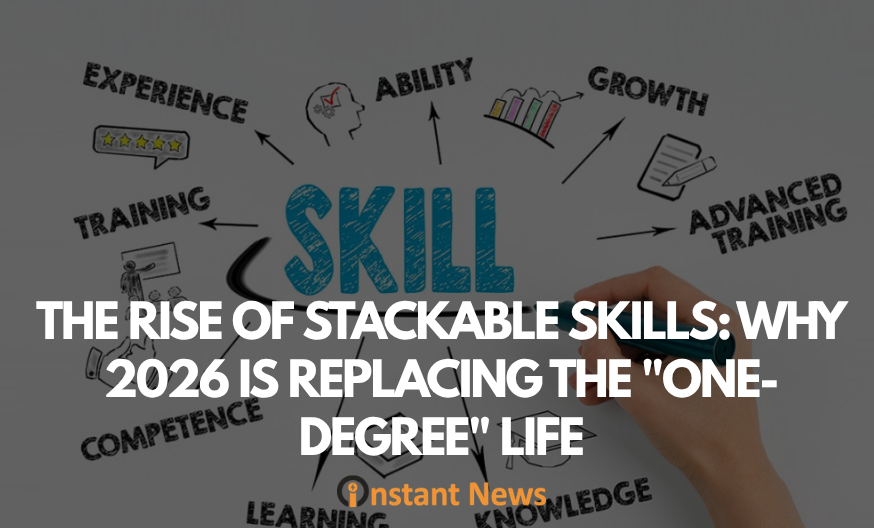
For decades, the standard path to success was a straight line: four years of university, a single degree, and a career that lasted forty years. But as we move through 2026, that line has officially shattered into a vibrant, flexible mosaic. We are witnessing the most significant shift in learning history especially the Stackable Skills, since the industrial revolution.
Welcome to the era of Stackable Skills.
This is not just another corporate buzzword. It is a fundamental “unbundling” of higher education. As traditional degrees struggle to keep pace with the blistering speed of technology, learners are opting for bite-sized, verifiable, and immediately applicable qualifications. The Stackable Skills movement is currently one of the most explosive topics in search engines, driven by a global workforce that no longer has the time—or the patience—for four-year delays.
What Exactly are Stackable Skills?
At its heart, this trend is about modularity. Instead of earning one massive credential, students are building a “portfolio of competence” by stacking micro-credentials, nano-degrees, and digital badges. These are short, focused certifications that verify a specific mastery—be it “Prompt Engineering for Marketing” or “Sustainable Supply Chain Management”.
The core components of the Stackable Skills ecosystem include:
- Micro-credentials: Certifications that can be earned in weeks or even hours, offering immediate relevance to current job openings.
- Digital Badges: Data-rich, tamper-proof records of achievement that can be shared instantly on professional networks like LinkedIn.
- Modular Degrees: Traditional universities are now allowing students to “stack” these smaller certificates toward a full Master’s or MBA over several years.
- Industry-Aligned Learning: Courses designed in direct partnership with tech giants to ensure the skills taught are exactly what is being hired for today.
The Spicy Appeal of “Skill-Based Hiring”
Why is this trend catching fire in 2026? Because the “Degree Ceiling” is finally cracking. Major employers—including Google, IBM, and Apple—have largely removed degree requirements from their job postings, prioritizing verified results over prestigious diplomas.
There is a certain “spice” to this new reality. It’s a democratization of opportunity. It suggests that a person’s value isn’t determined by where they were at age 18, but by what they have learned in the last six months. This shift toward Stackable Skills tells the world you are an active, lifelong learner who is ready for the “in-flow-of-work” economy. It provides a “dopamine hit” of accomplishment with every badge earned, keeping learners motivated in a way that a long-term degree simply cannot.
Mastering the Portfolio: How to Stack in 2026
If you want to stay relevant in this upcoming wave, you need to think like a curator, not just a student. The beauty of Stackable Skills lies in its personalization—it allows you to tailor your education to your specific career goals without the “filler” content of traditional curricula.
- The Foundation: Core Literacy
In 2026, AI literacy is no longer an elective; it is the baseline. Your first “stack” should always be a verified credential in AI fluency or prompt engineering, regardless of your industry. This ensures you can work alongside the machines rather than being replaced by them.
- The Specialization: Niche Competence
Once you have the foundation, you stack “niche” skills. For a graphic designer, this might mean a micro-credential in “AR/VR Interface Design.” For an SEO expert, it might be a badge in “Predictive Data Analytics”. These targeted additions make your resume “pop” in search algorithms.
- The Human Edge: Soft Skill Verification
As AI handles the technical heavy lifting, “Human Skills”—creativity, critical thinking, and empathy—have become the ultimate superpower. In 2026, we are even seeing micro-credentials for “Cross-Functional Collaboration” and “Emotional Intelligence in Leadership”.
The Psychology of the “Lifelong Journey”
Education experts suggest that the rise of Stackable Skills is a response to the “demographic cliff” and the rapid aging of the global workforce. We can no longer afford to stop learning at 22. By 2026, the concept of “graduation” has been replaced by “continuous professional growth”.
This movement embraces the “human factor”. It recognizes that people have families, jobs, and lives that don’t always fit into a rigid academic calendar. It offers a path for “career switchers” and adult professionals to pivot into new industries without starting from zero. In 2026, we are dressing our minds for the careers we want next week, not just next decade.
Why Search Engines Love This Right Now
From a digital perspective, the Stackable Skills trend is a massive growth driver for EdTech platforms. It is a “breakout” topic because it hits the sweet spot of being highly practical and search-optimized. People are moving away from broad queries like “best college” and toward specific, intent-driven searches like “best Python certification for finance” or “AWS cybersecurity badge cost”.
As we move toward the end of the year, expect to see even more universities unbundling their courses to offer “taster” modules. The smart institutions are those that realize they are now in the business of “career navigation,” not just lecturing.
Final Thoughts: Be the Architect of Stackable Skills
The most important “accessory” for this trend is a growth mindset. The Stackable Skills movement is about reclaiming your agency. It is the realization that your education is a living, breathing asset that you build brick by brick.
So, stop waiting for a four-year window to open. Start stacking. Whether you’re an aviation enthusiast or a beverage brand founder, the future belongs to those who can prove what they know, right now. Education is finally getting its agility back, and it looks a lot like a digital badge.